
Three Questions, One Chance: The New UCAS Personal Statement and What International Students Should Do This Summer

For students currently in Year 12 (or its equivalent within another national system) who are intending to apply to a UK university for 2027 entry, there is a significant change to understand before the summer recess begins.
The UCAS personal statement has been fundamentally reformed. The open-ended essay that previous applicants spent months crafting (a single, continuous piece of writing intended to capture academic motivation, extracurricular engagement, and future ambition within 4,000 characters) has been replaced entirely. In its place are three structured questions, each requiring a specific and evidence-based response.
This is not a cause for alarm. It is, however, a compelling reason to begin preparation considerably earlier than many students instinctively assume.
What Has Changed
From 2026 entry onwards, all UCAS applicants, whether based in the UK or applying from abroad, are required to respond to three structured questions rather than composing a traditional free-form personal statement. The format applies in full to 2027 entry, and UCAS has given no indication of a return to the previous approach.
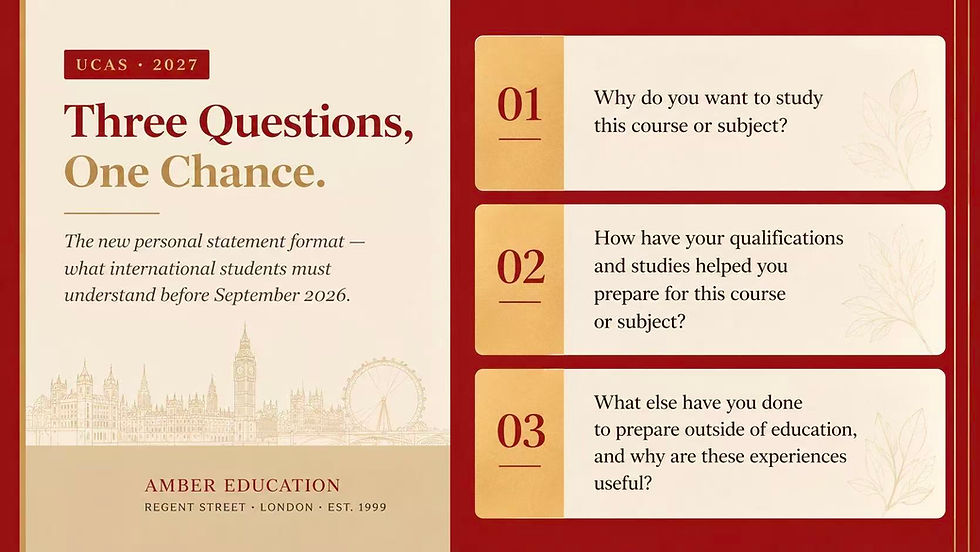
The three questions are as follows:
Question 1: Why do you want to study this course or subject?
Question 2: How have your qualifications and studies helped you to prepare for this course or subject?
Question 3: What else have you done to prepare outside of education, and why are these experiences useful?
Applicants have 4,000 characters in total across all three responses, with a minimum of 350 characters required per question. Admissions tutors will consider the responses as a coherent whole, which means repetition is penalised and thematic consistency is rewarded.
Why This Format Is More Demanding Than It Appears: Particularly for International Applicants
The structure may appear straightforward. In practice, many students, and particularly those educated outside the United Kingdom, find the new format considerably more challenging than its predecessor, for several interconnected reasons.
The questions demand specificity rather than enthusiasm.
Question 1 is not an invitation to declare a longstanding passion for a subject. Admissions tutors at competitive universities read many thousands of applications each cycle, and generic expressions of interest carry little persuasive weight. What they are looking for is evidence: a particular text that altered the applicant's thinking; a concept encountered in class and subsequently pursued through independent reading; a concrete intellectual encounter that substantiated the student's commitment to the discipline. Enthusiasm without evidence is, in the context of a university application, largely unremarkable.
Question 2 requires honest and precise self-assessment.
International students face a layer of complexity that their UK-educated counterparts do not. Those who have been schooled under a different national curriculum (the Chinese Gaokao, the Indian CBSE, the French Baccalauréat, or any number of other systems) cannot simply enumerate their subjects and assume that an admissions tutor will appreciate their rigour or relevance. The task is one of translation: presenting an academic background shaped by a different educational tradition in terms that are intelligible and persuasive within the context of the intended UK course.
Question 3 is where international applicants most frequently underestimate themselves.
The tendency, when writing in a second or third language about experiences drawn from a different cultural context, is to describe activities briefly and leave them unanalysed. UK universities are not principally interested in a catalogue of what a student has done. They wish to understand what the student derived from each experience, and how that connects to their academic interests and motivations. A research project, a debating competition, a period of work experience: any of these can constitute compelling evidence, but only if the applicant explains their significance rather than simply asserting it.
The Key 2027 Deadlines
UCAS applications for 2027 entry open on 1 September 2026. The principal deadlines are as follows:
15 October 2026: Applications to Oxford, Cambridge, and all courses in Medicine, Dentistry, and Veterinary Science
13 January 2027 at 18:00 (UK time): All other undergraduate courses
It is worth emphasising that, for international students, these dates represent the outer boundary rather than the target. An application submitted in January allows very little time for offer decisions to be reached, conditions to be met, and a UK student visa to be processed ahead of a September 2027 start date. For the majority of students we advise, we recommend having a completed and reviewed application ready to submit by November 2026 at the latest.
For this to be achievable, the substantive drafting of the personal statement should be under way by September, which in turn means that the preparatory work (identifying relevant experiences, clarifying subject focus, mapping the academic profile to the chosen courses) ought to begin during the summer.
Making Good Use of the Summer
The coming weeks represent a period of considerable opportunity for applicants who choose to use them purposefully. The following guidance may prove useful.
Establish a precise subject focus before writing. The new format rewards applicants who can articulate a specific and well-reasoned interest within their chosen discipline, rather than a general enthusiasm for a broad field. A student applying for Law would do well to consider whether their interest lies in international law, criminal justice, human rights, or commercial practice. An applicant for Economics might reflect on whether it is development economics, behavioural economics, or macroeconomic policy that most engages them. The greater the clarity of focus, the more purposeful and persuasive each response is likely to be.
Assess academic preparation honestly and systematically. Working through transcripts and course syllabi, applicants should identify the modules, topics, and projects that bear most directly on their intended course of study. This material forms the foundation of Question 2. Where gaps exist (topics not covered within the home curriculum that UK applicants would typically have encountered), it is worth considering whether independent reading or structured online study over the summer might help to address them.
Record extracurricular experiences in detail, and reflect on their significance. Before these experiences can be written about effectively, they must be remembered with precision. Students are advised to compile a thorough record of everything relevant (books read beyond the syllabus, competitions entered, internships undertaken, research projects pursued, community activities with an academic dimension), noting for each not merely what occurred, but what was learnt from it and why it is pertinent to the application.
A Note on Artificial Intelligence
It is worth addressing directly the use of AI writing tools in the drafting of personal statements, since this is a question we encounter with increasing frequency.
We would counsel against any substantial reliance on such tools, not only for the pragmatic reason that universities are becoming more adept at identifying AI-generated prose, but for a more fundamental one. The reformed UCAS format has been designed explicitly to elicit the authentic voice and genuine intellectual history of the individual applicant. A response produced, or substantially shaped, by an AI will not reflect the student's actual thinking, their real experiences, or their considered reasons for choosing a particular course. Admissions tutors at selective institutions are experienced and attentive readers; they will generally recognise when a piece of writing lacks the texture and specificity of genuine reflection.
The strength of a well-written personal statement derives precisely from its authenticity. That quality cannot be outsourced.
How Amber Education Can Help
Our UCAS advisers work with students from the earliest stages of subject and university selection through to the submission of the final application. As official representatives of more than 110 UK universities, our consultants bring an informed understanding of what individual admissions teams are seeking, a perspective that goes considerably beyond what is available through publicly accessible guidance.
For students currently in Year 12 or its equivalent, the present moment is the right point at which to begin. An initial consultation typically lasts one to two hours and provides a clear assessment of where the student stands, what the application requires, and how the months ahead might most productively be used.
To arrange a consultation with our UCAS team, please contact us at marketing@amberedu.co.uk or telephone our London office on 020 7734 0274. Amber Education, 2/F Kingsland House, 122–124 Regent Street, London W1B 5SA.


Comments